Understanding the digital FSQA landscape through business capabilities, information and evidence.
Consider a food manufacturer receiving an international alert about pesticide residues detected in an imported ingredient. The alert may be relevant. But it does not tell the company whether its own ingredients are affected.
Answering that question may require several digital systems. A regulatory database reports the incident. A supplier platform holds information about ingredient origins. A laboratory system manages analytical results. A traceability application identifies related shipments. An operational food safety platform helps document investigations and corrective actions. Each system contributes something different. None necessarily contains all the information required to decide what to do.
This is what interested me while examining digital systems used in food safety and quality management. We often describe these products collectively as food safety software. But are we really discussing comparable systems? And what can each of them reasonably tell us?
1. Are we classifying the same kinds of systems?
The first difficulty is terminology.
A Food Safety Management System (FSMS), as described in standards such as ISO 22000, includes the organizational processes, responsibilities, resources and controls through which food safety is managed. Food safety management software is a commercial product category. Software can support many activities within an FSMS, but it does not constitute the entire organizational management system.
The distinction becomes more complicated when examining the wider digital landscape. A Laboratory Information Management System (LIMS) is primarily defined by the laboratory workflows it supports. A traceability application manages product identities and movement records. An intelligence service monitors external information about hazards and emerging risks. A broader FSQA platform may combine several of these capabilities. Meanwhile, terms such as cloud, blockchain and artificial intelligence describe technologies rather than food safety activities.
These are different classification principles: business functions, information resources, software architectures and technological capabilities. When they are mixed together, systems that perform complementary roles can appear to belong to competing software categories. This may serve some commercial purposes. But it is less useful when trying to understand how digital systems contribute to food safety decisions.
A different starting point might be more helpful: What primary food safety activity, workflow or decision does the system support?
2. A functional map of the digital FSQA landscape
I have been exploring this question through a preliminary classification of digital systems used in food safety and quality assurance.
The starting references include the Codex General Principles of Food Hygiene, ISO 22000 and the GFSI Benchmarking Requirements, Version 2024. These describe important functions, responsibilities and assurance requirements in food safety management, although they do not prescribe a taxonomy of software products. Other references, including the GS1 Global Traceability Standard, help explain how information is identified, recorded and exchanged across supply chains.
Academic research adds another perspective. For example, Sartoni and colleagues examined opportunities and constraints in digitalizing prerequisite programs and HACCP activities, while Zhou, Brereton and Campbell reviewed the development of intelligent food assurance systems across safety, quality, authenticity and food defence. Neither study establishes a comprehensive classification of commercial FSQA software.
By comparing these perspectives with the principal functions represented in a preliminary survey of software products and information services, I developed a provisional taxonomy of ten business capabilities. These cover:
- FSQA governance and continuous improvement;
- hazard analysis and preventive controls;
- supplier and raw-material assurance;
- product and specification assurance;
- site FSQA operations and monitoring;
- laboratory and analytical evidence management;
- traceability and supply-chain visibility;
- external food safety surveillance and intelligence;
- audit, certification and assurance;
- incident, recall and crisis management.
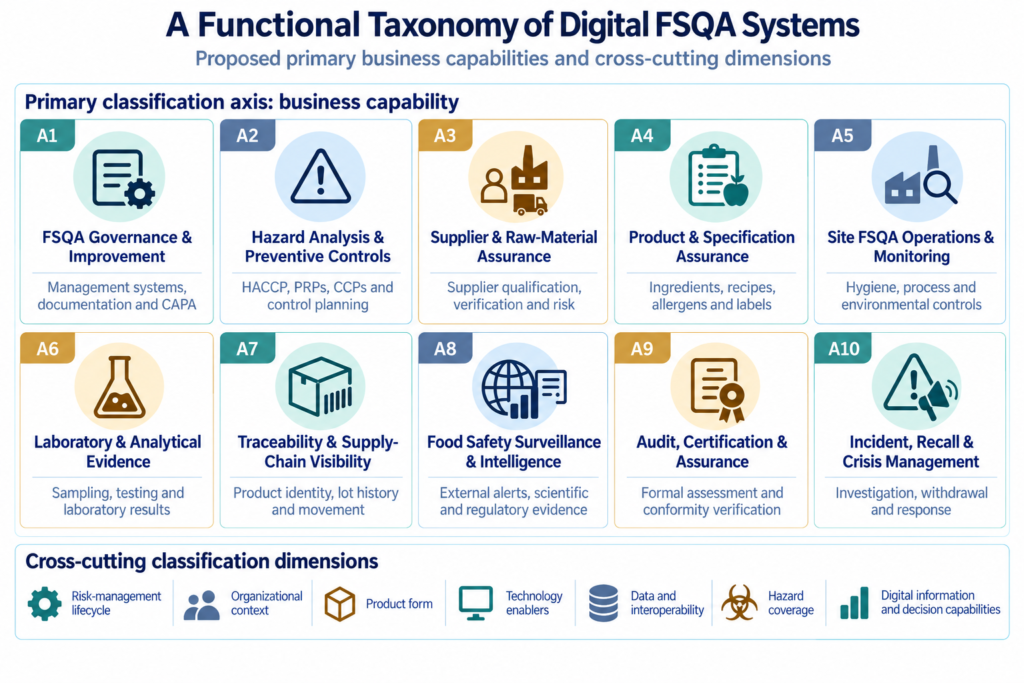
The categories are complementary, not sequential. A supplier assurance platform, for instance, may also manage specifications, certificates, audits and risk assessments. Its primary purpose may remain supplier assurance, while those additional functions are recorded as secondary capabilities. Similarly, an integrated platform may cover several categories without fitting exclusively into one.
The proposed taxonomy therefore uses business capability as its primary classification while allowing other dimensions to describe where systems operate, what information they use, which technologies they apply and what risk-management activities they support.
Some boundaries remain open to refinement, particularly between governance and auditing, operational monitoring and preventive controls, or external intelligence and supplier risk assessment. That is part of the research. The objective is not to force every product into a convenient box, but to develop a classification that can be applied consistently.
The functional categories also provide a starting point for another question, which I find at least as interesting.

3. Different systems, different kinds of evidence
Even when several systems contribute to the same food safety decision, they may work with fundamentally different kinds of information. A preliminary review of representative systems illustrates these distinctions.
| Digital system | Information it primarily handles | What it can help establish |
|---|---|---|
| Regulatory alert database | Official notifications and reported incidents | Where a problem has been reported |
| Food safety intelligence service | External alerts, scientific and regulatory information | Which developments may require further assessment |
| Supplier assurance platform | Supplier records, specifications and certificates | What is documented about suppliers and materials |
| Laboratory information system | Samples, analytical methods and results | What was measured in the samples examined |
| Traceability application | Product identities, lots and movement records | Which materials, locations and events are connected |
| Operational FSQA application | Monitoring records, deviations and corrective actions | What controls and activities have been recorded |
These are different kinds of evidence, with different strengths and limitations. Let’s consider again the example of an imported ingredient:
- A notification in the European Commission’s Rapid Alert System for Food and Feed (RASFF) establishes that a food or feed issue has been reported through an official information network. It does not necessarily establish that another company’s ingredient is affected.
- A supplier certificate may document compliance with specified requirements. Its significance depends on what was assessed, by whom, using which methods and under which conditions.
- A laboratory result provides evidence about the sample tested. Whether that result represents a particular shipment or a broader group of materials depends on the sampling approach, analytical method, uncertainty and other considerations.
- Traceability records may establish relationships between suppliers, shipments and production batches. They do not, by themselves, establish contamination.
Each source answers a different question. The challenge is not simply to collect more information. It is to understand what each piece of evidence establishes, what it does not establish, and how different pieces can be combined. That brings us to the information architecture underlying the software.
4. Connecting systems is not the same as connecting knowledge
Software integration is often discussed in terms of APIs, interfaces and data exchange. These matter. But transferring information between two applications does not guarantee that the receiving system can interpret it correctly.
Suppose an international alert refers to a particular ingredient, chemical contaminant and geographical origin. To evaluate its relevance, a manufacturer may need to connect the alert with ingredient specifications, supplier identities, production records and laboratory results. The systems must recognize compatible entities and relationships. They must also preserve context: when an observation was made, where it originated, how it was measured and what uncertainty remains. The GS1 EPCIS standard addresses part of this challenge by establishing common ways to represent and exchange information about supply-chain events. Its event model can describe what was involved in an activity, when and where it occurred, its business context and, where appropriate, relevant conditions.
This provides useful infrastructure for traceability. But sharing a traceability event is not the same as interpreting scientific evidence. A traceability record, a laboratory measurement and a regulatory notification describe different aspects of the food supply chain. Combining them requires compatible identifiers, consistent terminology, meaningful relationships and reliable provenance.
It also requires clarity about information rights and responsibilities. Public regulatory information, supplier declarations, laboratory reports and commercial intelligence services operate under different conditions of access, reuse and accountability. Not every dataset can or should be made universally accessible. But important connections may still depend on shared standards, trusted reference information and agreed mechanisms for exchange.
A 2025 study by Sartoni and colleagues identifies technological fragmentation, system adaptability, training and organizational considerations among the constraints facing digital FSMS adoption. These findings reinforce the importance of looking beyond the availability of software functionality. Interoperability is therefore more than a technical connection between applications. It is also about preserving meaning, evidence and responsibility across organizational boundaries.
This is where software classification intersects with the wider question of shared food safety knowledge infrastructure.
5. From information management to decision support
There is another way to examine what these systems contribute. Rather than asking only which business function they support, we can ask what they actually do with information. I have been exploring six complementary digital capabilities:
Record · Connect · Interpret · Anticipate · Decide · Act & Learn
Recording captures observations, measurements and events. Connecting establishes relationships between information from different sources. Interpreting helps identify patterns and understand what the available evidence may indicate. Anticipating involves estimating possible future developments, together with their uncertainty. Deciding involves evaluating options and supporting professional judgment. Acting and learning connects decisions with interventions, verification and continuous improvement.
These are proposed analytical distinctions, not a validated maturity model. A laboratory information system can create substantial value through reliable management of analytical evidence without predicting future contamination. A traceability application may be particularly important for establishing relationships between products, locations and events. An intelligence service may help professionals recognize developments that deserve further investigation.
Some systems support several capabilities. Others specialize in one or two. The point is not that every application should eventually predict risks or recommend actions. It is to understand the contribution each makes to a wider decision-making process.
This also exposes an important boundary between software functionality and organizational practice. A system may record a deviation without ensuring that somebody investigates it. An analytical application may identify a pattern without establishing its cause. An alert may reach a professional without changing a sourcing or testing decision.
The technology supports the process, but it does not necessarily complete it. What matters is whether information becomes sufficiently reliable, relevant and timely for someone to decide what should happen next.
©Phil Crow 2023
6. What changes when AI enters the picture?
Artificial intelligence adds another set of possibilities, but it does not eliminate these distinctions.
An application may use AI to extract information from certificates, summarize regulatory documents or classify incoming reports. Another may detect unusual patterns in monitoring data or estimate possible future developments. These tasks differ considerably.
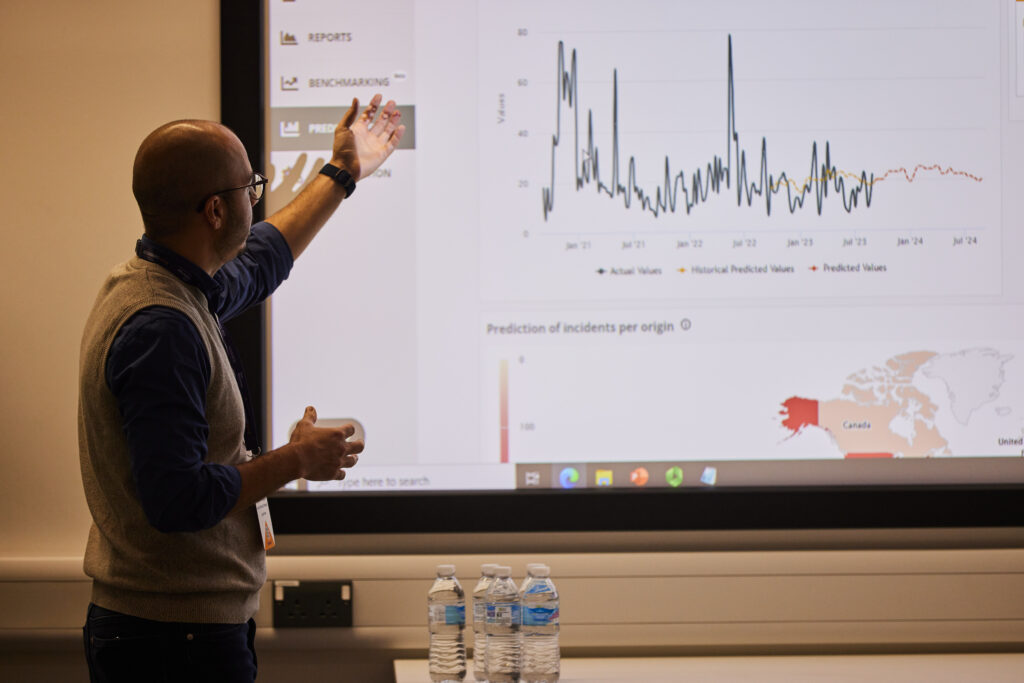
Document summarization can improve access to information. Anomaly detection can help focus attention on unexpected observations. Prediction introduces additional questions about the reliability of estimates and their relevance to specific decisions. None of these capabilities should automatically be described as prevention.
My preliminary software survey identified publicly described AI functionality in several products, but it did not establish independent evidence connecting those functions to improved preventive outcomes. This does not demonstrate that the technologies are ineffective. It means their contribution cannot be established from product descriptions alone.
In my view, three questions must remain distinct:
What functionality is available? How reliably does it perform? And does using it lead to better decisions or outcomes?
A more sophisticated model may process information faster or recognize patterns that conventional methods could miss. But its usefulness still depends on the available evidence, the validity of its conclusions and the decisions to which it contributes. AI may change what different systems can do. It does not remove the need to understand what their information means.
Understanding the landscape before transforming it
The digital FSQA landscape is more diverse than a single software-market category suggests. Some systems produce or manage analytical evidence. Others organize operations, establish traceability relationships, monitor external developments or support investigations. They have different purposes, work with different kinds of information and contribute to different decisions.
A functional taxonomy provides one way to make these distinctions visible. Examining their data foundations adds another, potentially more important, perspective. This type of research is still evolving. Its categories need further testing, and the actual interoperability and analytical capabilities of individual products require more detailed assessment.
Nevertheless, it has reinforced an important question for me: Before asking whether AI can make food safety more predictive, do we sufficiently understand how today’s digital systems produce, connect and interpret the evidence on which decisions depend?
The next advances may come from more sophisticated analytical models. They may also come from better data quality, shared identifiers, interoperable information resources or more effective integration into operational decisions. Different problems will require different combinations. The value of digital technology ultimately depends not on how many capabilities a platform offers, but on what professionals can reliably establish and do with the information it provides.
Research methodology and limitations
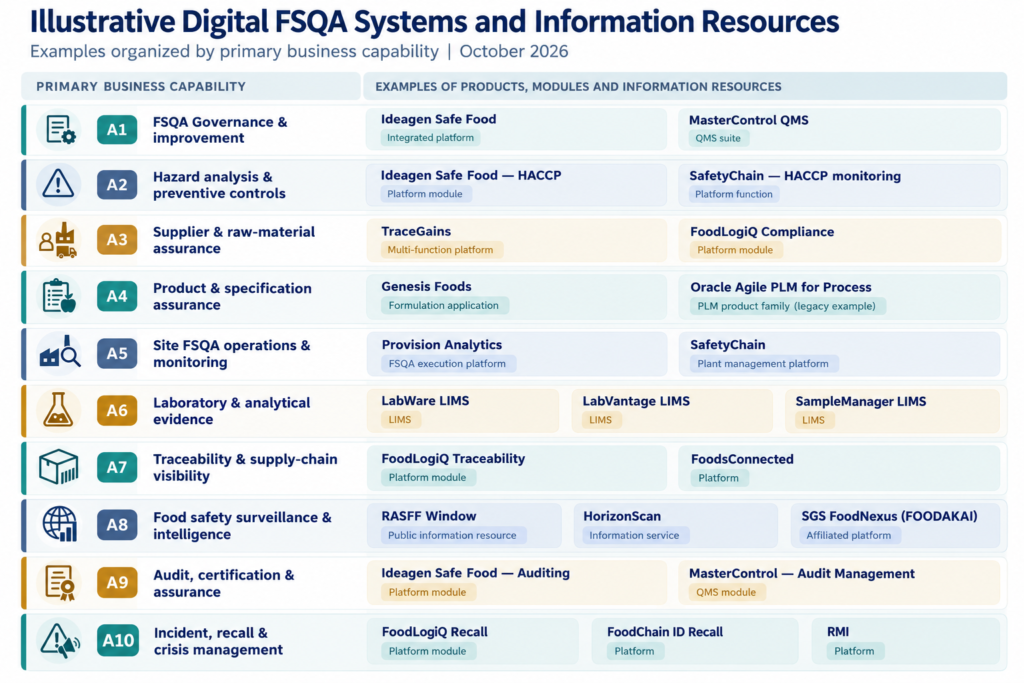
This article is based on exploratory research conducted in October 2026, drawing on international food safety frameworks, data and interoperability standards, academic publications and publicly documented software capabilities. A provisional taxonomy was synthesized by comparing established FSQA activities with the principal workflows represented in a preliminary survey of 16 tabulated system entries and additional identified products. The survey was purposive rather than systematic or exhaustive. The ten business capability categories and six digital capabilities are original analytical proposals, not established standards or validated maturity models. Product information was principally obtained from public documentation; no independent software testing or comparative performance validation was conducted. The supplementary map of representative systems (Figure 2) illustrates the classification. Product examples are not endorsements or rankings.
Disclosure: I serve as Co-CEO of SGS FoodNexus, whose platform is included among the illustrative systems in the map.
Principal references
- Codex Alimentarius Commission. General Principles of Food Hygiene, CXC 1-1969. Revised 2022.
- International Organization for Standardization. ISO 22000:2018 — Food safety management systems.
- Global Food Safety Initiative. Benchmarking Requirements, Version 2024.
- GS1. Global Traceability Standard and EPCIS / Core Business Vocabulary.
- U.S. Food and Drug Administration. New Era of Smarter Food Safety Blueprint. 2020.
- European Commission. Rapid Alert System for Food and Feed.
- Sartoni, M., et al. (2025). Towards digitalisation of food safety management systems – enablers and constraints. Food Control, 168, 110952.
- Zhou, J., et al. (2024). Progress towards achieving intelligent food assurance systems. Food Control, 164, 110548.
Documentation for the systems illustrated in Figure 2
Links below lead to public provider or institutional documentation. They establish the described product or module identity and advertised functions, not independent performance validation. Repeated products appear where distinct functions are illustrated.
A1 — Governance: Ideagen Safe Food; MasterControl QMS.
A2 — Preventive controls: Ideagen Safe Food (HACCP); SafetyChain.
A3 — Supplier assurance: TraceGains Supplier Management; FoodLogiQ Compliance.
A4 — Product and specifications: Genesis Foods; Oracle Agile PLM for Process (legacy product documentation).
A5 — Site operations: Provision Analytics; SafetyChain.
A6 — Laboratory: LabWare LIMS; LabVantage LIMS; Thermo Scientific SampleManager LIMS.
A7 — Traceability: FoodLogiQ Traceability.
A8 — Surveillance: European Commission RASFF Window; Fera HorizonScan; SGS FoodNexus.
A9 — Audit workflows: Ideagen Safe Food auditing; MasterControl Audit Management.
A10 — Recall: FoodLogiQ Recall.
This article is an independent professional reflection and does not represent the views or positions of SGS or SGS FoodNexus.